
Industry Applications
Siltation doesn't stop, and the berth still has to take the vessel. We supply dredging pumps and packages for maintaining depth in harbours, marinas, locks and intakes, and for clearing material around offshore structures.
What you're usually dealing with
Harbour siltation is a recurring maintenance problem rather than a one-off job. Material accumulates in berths, approach channels, lock entrances and behind quay walls, and the clearance under a vessel's keel shrinks until something has to be done about it. The work usually has to happen around live vessel movements, which means short windows, tidal constraints, and a plan that can stop and restart without leaving a pipe full of settled sand.
Water intakes and outfalls silt up on the same cycle, and for a power station or process plant a restricted intake is a production problem rather than a navigational one.
Offshore, the common jobs are clearing scour around monopiles and structures, exposing or burying cables and pipelines, and clearing material away from connection points and jack-up locations. Access is by vessel or jack-up, so mobilisation is expensive and anything that can't be fixed in place has to come back to shore.
Everything in seawater is a corrosion problem as well as an abrasion problem, and material selection has to cover both. Disposal is licensed, and depositing dredged material at sea requires a marine licence, with sampling and characterisation needed before an application.
How we'd approach it
The first questions are access and window. How the pump gets to the material, how long you have in each working period, and whether the operation has to shut down and restart around tides or vessel movements. A system that can't be flushed and restarted cleanly will cause more delay than it saves.
Material and depth come next, along with whether the arisings are going to a licensed disposal site, to a hopper, or to a dewatering area ashore, since that sets the discharge arrangement and the distance.
For marine work we'd specify high-chrome wet ends for the abrasion and corrosion-resistant materials throughout, including fasteners and cable glands, because a pump that survives the sand and then fails on a seal is no better off.
Standby capacity is worth more offshore than almost anywhere else. On the London Array job we supplied a duty pump and a standby, because a breakdown with everything arriving by vessel costs days rather than hours.
Where the pump is working at depth and can't be watched, we'd build in soft-start control and monitoring so the operator can see what's happening from the deck.
Kit we'd normally look at
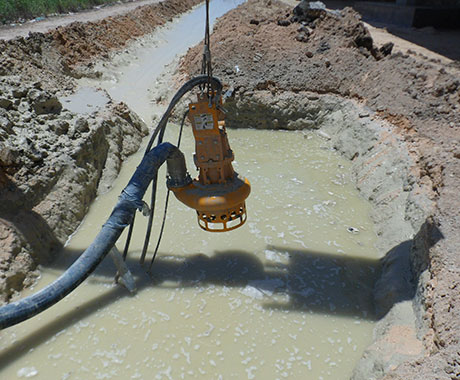
- Dragflow submersible dredging pumps with high-chrome wear components
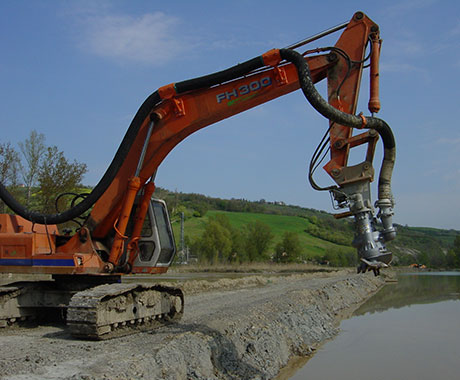
- Crane-suspended, pontoon-mounted and excavator-mounted arrangements
- Corrosion-resistant materials throughout for seawater service
- Agitators and cutter heads matched to the seabed material
- Electronic soft-start control panels, deck mounted
- Generators sized to the pump and its starting current
- Duty and standby pumps for vessel-based work
- Discharge pipework and hose for long runs
Hire or buy
Port authorities and operators facing an annual or seasonal maintenance cycle often buy, since the requirement recurs indefinitely. Contractors working a defined scope normally hire.
A job like this
At the London Array in the outer Thames Estuary, VBMS needed a cable termination point cleared at 20 metres depth before connection work could go ahead. Two Dragflow pumps working from a barge moved up to 100 tonnes of sand an hour and came out showing no signs of wear.
Tell us what's down there
Send us the depth, the access arrangement and whatever you know about the material and we'll tell you what it needs.
Call 01892 832144 in the UK, 1 410 5730 in Ireland, or email sales@euroflo.com.
Harbour & Offshore Dredging applications
- TBC
- TBC
- TBC
Contractors across UK rely on Euroflo for dredging solutions
Whether your project requires temporary construction dewatering we have the knowhow and experience to keep your project flowing safely and efficiently.
Get in Touch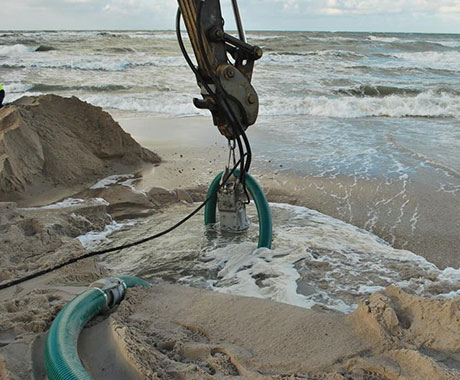
Some of the projects we have worked on...



Pumping