
Industry Applications
We supply the pumps, controls and power for keeping excavations dry, from a single sump pump in a basement dig through to staged systems running for the length of a build.
What you're usually dealing with
Surface water and groundwater are different problems. Surface water arrives in bursts after rain and is mostly a question of volume. Groundwater is continuous and determines whether you're pumping for a fortnight or for the whole programme.
The ground type sets the method. Sump pumping is the cheapest approach and works well in gravels and coarse material, but in fine sands and silts it can draw fines out with the water and loosen the base of the excavation. Wellpoints work on suction, giving around 5 to 6 metres of drawdown per stage, so greater depths mean benching down. Deep wells with submersible borehole pumps cover the deeper and higher-yielding ground, and ejector systems handle low permeability silts where a deep well wouldn't yield enough to justify the borehole.
Discharge is the other half of it. A watercourse discharge needs an Environment Agency permit with a suspended solids limit attached, so settlement tanks or a lagoon have to be in the site layout. Discharge to sewer needs a trade effluent consent and the water company will set a maximum rate. Lead times on both run to several weeks.
Iron-rich groundwater oxidises on contact with air and forms ochre, a bright orange deposit that blocks wellpoint screens and filter packs and affects what the Environment Agency will accept at the discharge point.
How we'd approach it
We're not a geotechnical contractor and we don't design the dewatering scheme. We specify the pumps, controls and power within whatever the designer has set, and we'll say so if the duty we've been sent doesn't match the method described.
To do that we'd want the ground investigation, the excavation profile and depth, how long the excavation needs to stay dry, and where the water is going. Depth and flow rate on their own aren't enough, since the same excavation in chalk and in silty clay needs different answers.
We'd also ask how the site runs. Automatic level control on probes or floats is standard, since the system has to work when the site is closed. Where a flooded excavation would cost a day or more, we'd specify a standby set and a telemetry alarm that dials out rather than one that flashes on a panel.
If there's no mains supply we'd size the generator alongside the pumps rather than after them, because a set undersized on starting current will trip each time the pump cuts in. Since construction lost its red diesel entitlement in April 2022 the gap between diesel and electric running costs has narrowed, so on long-duration jobs the comparison is worth running properly.
Kit we'd normally look at
- Grindex drainage pumps, 110v portable up to larger three-phase sets, for surface water and light silt loading
- Grindex sludge pumps where a drainage pump would block
- Grindex INOX stainless steel models for aggressive ground conditions
- EcoFlo pumps [confirm positioning and where this range fits against Grindex]
- Level control, probes, float switches and alarms
- Duty and standby arrangements where downtime isn't affordable
- Generators, control panels and cabling supplied alongside the pumps
Hire or buy
Most dewatering is hired, because the requirement ends when the build does.
Buying tends to make sense for contractors running the same duty across multiple sites year after year. We'll tell you when we think you're at that point.
A job like this
On the Connaught Crossing, the water had been pumped out of two cofferdams and left 15 metres of silt behind it, which took the job beyond dewatering and into slurry handling.
At Newhaven, the discharge conditions were tight enough to rule out conventional groundwater pumping altogether, so the build was designed around it.
A job like this
Send us the ground investigation and the programme and we'll tell you what we'd do with it. Call 01892 832144 in the UK, 1 410 5730 in Ireland, or email sales@euroflo.com.
Construction Dewatering applications
- TBC
- TBC
- TBC
Contractors across UK rely on Euroflo for dredging solutions
Whether your project requires temporary construction dewatering we have the knowhow and experience to keep your project flowing safely and efficiently.
Get in Touch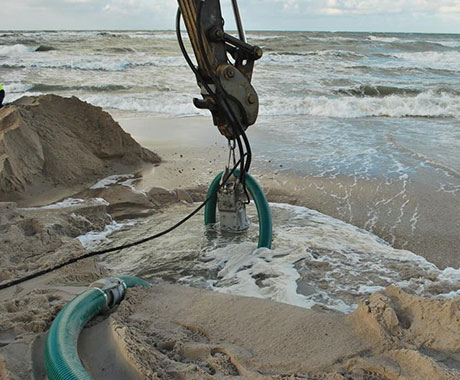
Some of the projects we have worked on...




Pumping